Build Experience. Build Skills. Build Direction.
How to Become an MRI Technologist Without a Four-Year Degree
In medical imaging, the certification is the credential — no four-year degree, and specialists clear $120K+. Here's the honest pay, the ARRT path, and the two-year route into the scan room.
CAREERS WITHOUT A COLLEGE DEGREEPOST HIGH SCHOOL PLANNING
Jon & Angela Stoyak
7/10/20265 min read
How to Become an MRI Technologist Without a Four-Year Degree
There's a job where you run the machine that lets a doctor see inside a person without ever cutting them open — spotting the tumor, the torn ligament, the thing no other test can find — and you can train for it in about two years, with no four-year degree and no medical school. It's called an MRI technologist, and it's one of the best-paid roles in all of healthcare that doesn't require a bachelor's. Let's look at what the work is, what it pays, and why the path is so much shorter than the responsibility suggests.
First principle: the diagnosis depends on the image, and the image depends on you
A doctor can't treat what they can't see. When something's wrong deep inside the body — a brain, a spine, a joint, an organ — the MRI is often the tool that finds it, and the quality of that scan determines whether the problem gets caught or missed. A rushed or poorly positioned image can hide the very thing everyone's looking for. The technologist running that machine isn't pushing a button; they're producing the single piece of information the whole diagnosis turns on.
Strip it down: value comes from being the person who produces the thing the expert can't work without. The radiologist reads the scan, but the technologist makes it exist — and makes it good enough to trust. That's indispensable, and indispensable is what pays, and what lasts.
Second principle: enormous responsibility and a long expensive path are not the same thing
Here's the assumption worth breaking. We see "works in a hospital, produces medical diagnoses" and our brain fills in "so that must take a decade and a medical degree." It doesn't. Most MRI techs enter through a two-year associate degree in radiography, then add MRI certification — not the many years a physician spends. The responsibility is real and serious. The on-ramp is short. We just assume the two always travel together, and they don't. Once you separate the weight of the work from the length of the schooling, a door most people walk right past swings open.
Worth knowing up front: MRI is a specialization most people grow into after starting as a radiologic technologist. If you haven't read it yet, our guide on how to become a radiologic technologist covers that entry-level starting point — MRI is the higher-paid step up from there.
What the job actually is
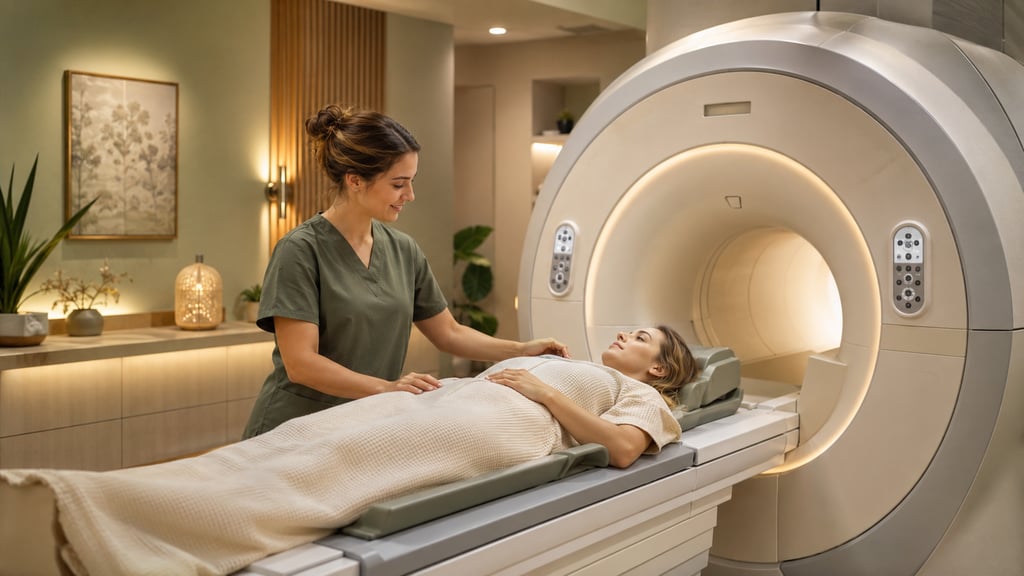
MRI technologists operate magnetic resonance imaging scanners — the large machines that use powerful magnets and radio waves to produce detailed images of the body's soft tissue. That means preparing and positioning patients, selecting the right imaging protocol, running the scan, keeping the patient calm and still (claustrophobia is real), and, critically, enforcing the safety rules that keep the magnet from turning a loose metal object into a projectile. It's technical, detail-driven, people-facing work for someone who likes precision and doesn't mind real responsibility.
Curious what other careers fit this same "short path, serious responsibility" pattern? Our guide to the 15 highest-paying jobs without a four-year degree lays out more of them.
What it pays
The median annual wage for MRI technologists was $88,180 in May 2024 (BLS) — well above the $49,500 median for all workers, and one of the highest medians of any career that doesn't require a bachelor's. The honest spread: the lowest 10% earned under about $64,910, and the top 10% earned more than $121,420.
Where you work moves the number hard. Entry-level techs typically start in the $55,000–$70,000 range. Hospitals often pay $5,000–$15,000 more than outpatient centers, and shift differentials for evenings, nights, and weekends add several dollars an hour on top. Specialties like cardiac, breast, or neuro MRI carry premiums, and dual MRI/CT credentials make you more valuable still. California and other high-cost states push medians well past $110,000, and experienced travel MRI techs can annualize into six figures. That range isn't random — it tracks certification, specialty, setting, and location, all of which are in your control.
How to get in without a four-year degree
Finish high school. Strong science, math, and comfort with technology and people give you a real head start.
Complete an accredited radiography program. Most MRI techs start with a two-year associate degree in radiologic technology from a JRCERT-accredited program — this is the standard on-ramp. (This is the same starting point covered in our radiologic technologist guide — worth reading if you're beginning from scratch.)
Get certified and add MRI. Earn your ARRT certification in radiography, then document MRI clinical experience to add the ARRT(MR) post-primary credential. That MRI certification is the income-leverage move — it's what separates a general rad tech from a higher-paid MRI specialist.
Get hired and specialize. Once working, stack skills: cardiac, breast, or neuro MRI, or a second modality like CT. Each one raises your rate.
You can be running scans in a hospital or imaging center, earning a strong healthcare income, in about the time it takes to finish two years of a four-year degree — and with far less tuition debt.
Is it worth it?
The field is projected to grow 5% through 2034 — faster than average — with steady openings driven by an aging population needing more imaging and ongoing retirements. And here's a question worth answering directly, because everyone asks it now: does AI replace MRI techs? No. AI is improving image reconstruction and measurement, but the scan still requires a person to position the patient, place IV contrast, manage claustrophobia, and — above all — enforce the safety protocols that keep people alive around a powerful magnet. It's one of the roles most protected against automation.
The honest tradeoffs: it's on-your-feet work, you'll lift and turn patients, hospital roles can mean nights, weekends, and on-call hours, and the safety discipline is non-negotiable — a single lapse around the magnet can be catastrophic. But for a roughly two-year on-ramp into essential, well-paid, high-tech healthcare work with no bachelor's required, few paths match it.
The principle underneath it all: the degree was never the thing — the skill and the certification are the thing. You don't need four years to hold a job a hospital depends on. Layer the accredited program, earn the ARRT credentials, add daily effort, and you build a stable, meaningful, well-paid life.
Ready to map your own path? The Foundational Bundle gives you all three of our core guides plus a workbook: More Paths Than You Think (high-paying careers without a four-year degree), the Post High School Plan (how to build your path step by step), and The AI Guide for Life After High School (how to put AI to work in whatever career you choose). Everything you need to pick a direction, build the skills, and turn them into income — no four-year degree required.
Just want the career roadmap? More Paths Than You Think is available on its own.