Build Experience. Build Skills. Build Direction.
How to Become a Radiologic Technologist (No 4-Year Degree)
Rad techs run the imaging every diagnosis depends on — and the path is a two-year associate's, no four-year degree. Here's the job, the honest pay, and the credential ladder that raises it.
CAREERS WITHOUT A COLLEGE DEGREEPOST HIGH SCHOOL PLANNING
Jon & Angela Stoyak
7/2/20263 min read
How to Become a Radiologic Technologist Without a Four-Year Degree
Every broken bone, every suspicious shadow on a lung, every "let's get a scan of that" starts with one person: the tech who runs the machine. Hospitals cannot diagnose without them, which means they cannot function without them. And you can become one in about two years, with an associate's degree and no four-year university bill. Here's how the job works, what it pays, and why the path is shorter than almost anyone realizes.
First principle: the job that sits at the bottleneck is the job that's always safe
Think about where a hospital literally cannot proceed without a specific person. A doctor suspects a fracture — nothing happens until someone images it. A patient comes in after a fall — no treatment plan exists until the scan does. Radiologic technologists sit at that bottleneck. The entire diagnostic process routes through them, every day, in every hospital in the country.
Strip it down and here's the truth: a job's security doesn't come from prestige or from how many years you studied. It comes from whether the system can run without you. It can't run without imaging. That's not a job — it's a permanent seat in the machine.
Second principle: you don't need the long path to reach the essential work
We've been taught that "important medical job" automatically means "many years of expensive school." For a doctor, sure. But the person actually operating the imaging equipment that doctors depend on? That's a two-year associate's degree. The essential work and the long expensive path were never the same thing — we just assumed they were. Once you separate them, a door opens.
What the job actually is
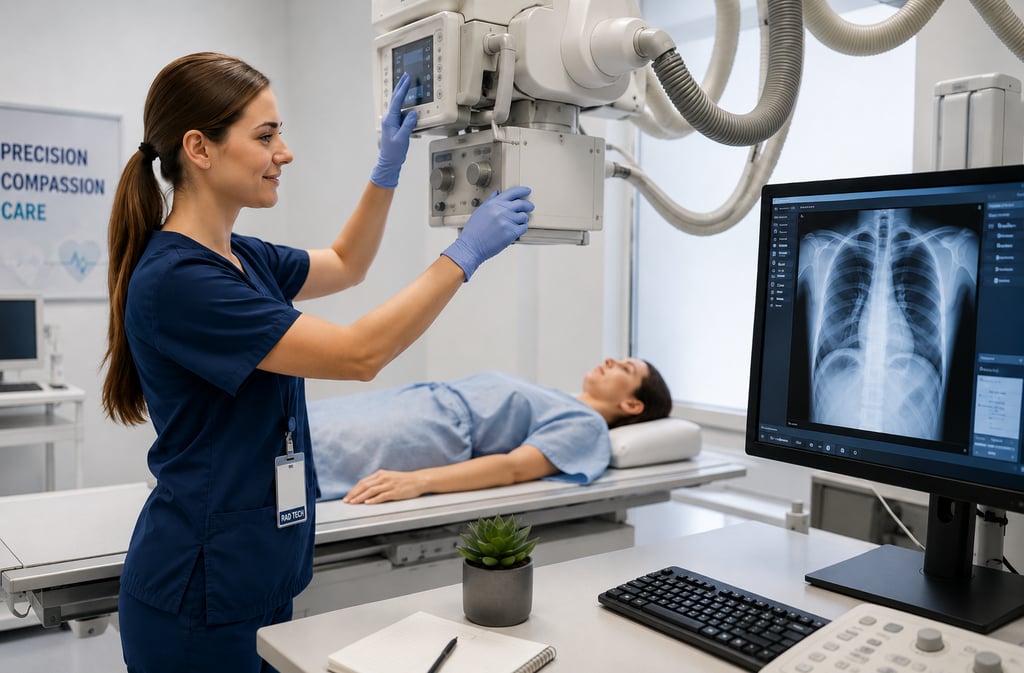
Radiologic technologists — rad techs — operate X-ray, CT, and related imaging equipment to create the pictures physicians use to diagnose and treat patients. You position patients, run the machine, protect everyone from unnecessary radiation, and produce clean, usable images. It's technical, hands-on, patient-facing work, done as part of the medical team.
What it pays
The median wage was $77,660 in May 2024 (BLS), with the top 10% earning over $106,990 — well above the $49,500 median for all workers. But here's the part that makes this path smart: the ceiling isn't fixed, and you raise it without going back for a four-year degree. Adding a specialty credential moves the number fast — MRI technologists earn a median of about $88,180, and CT, mammography, and interventional imaging all pay premiums. Your associate's degree isn't a ceiling; it's a launchpad you build on one credential at a time.
How to get in without a four-year degree
Earn an associate's degree in radiologic technology — typically two years, mixing classroom and clinical training. (A shorter certificate can work if you're already in healthcare.)
Choose an accredited program and get certified through the ARRT (American Registry of Radiologic Technologists) — most employers require or strongly prefer it.
Get licensed if your state requires it (most do); rules vary, so check your state board.
Add modalities to climb. MRI, CT, mammography — each credential raises your pay and your options, and you stack them while working.
Is it worth it?
The field is projected to grow 5% through 2034 with about 15,400 openings a year across radiologic and MRI roles, driven by an aging population needing more imaging. The honest tradeoffs: it's licensed, certification-driven work with real clinical training up front, you're on your feet, and hospital roles can mean nights and weekends. But for a two-year on-ramp into essential, well-paid, advancement-rich healthcare work — with no four-year tuition bill — few paths match it.
The principle underneath it: the degree was never the thing. The skill and the credential are the thing. You don't need four years to hold the job the whole hospital depends on. Layer the associate's, stack the modalities, add daily effort, and you build a lucrative life.
And whatever path you choose, learn to work alongside AI — imaging is one of the areas AI is changing fastest. A rad tech who uses tools like ChatGPT or Claude to study for ARRT exams and understands how AI-assisted image analysis fits into the workflow will be more valuable, not less. AI won't position the patient or run the machine — but the techs who understand it will lead.
If healthcare careers like this interest you, our guide to the 15 highest-paying jobs without a four-year degree covers more paths built the same way.
Ready to map your own path? The Foundational Bundle gives you all three of our core guides plus a workbook: More Paths Than You Think (high-paying careers without a four-year degree), the Post High School Plan (how to build your path step by step), and The AI Guide for Life After High School (how to put AI to work in whatever career you choose). Everything you need to pick a direction, build the skills, and turn them into income — no four-year degree required.
Just want the career roadmap? More Paths Than You Think is available on its own.