Build Experience. Build Skills. Build Direction.
How to Become a Welder Without a Four-Year Degree
In welding, the test is the credential — no four-year degree, and specialists clear $100K+. Here's the honest pay, the certification ladder, and the sub-18-month path from trade school to six figures.
CAREERS WITHOUT A COLLEGE DEGREEPOST HIGH SCHOOL PLANNING
Jon & Angela Stoyak
7/4/20265 min read
How to Become a Welder Without a Four-Year Degree
There's a trade where the test is the credential — no essays, no lectures, no four-year tuition. You pass the weld or you don't. And the welders who keep passing harder tests keep adding dollars to their paychecks, some of them clearing $100,000 a year on pipelines and rigs. You can start earning in under 18 months. Here's how it works, what it really pays, and why the ceiling is so much higher than the average suggests.
First principle: when the proof is the skill itself, the credential can't be faked — and that protects you
Most careers make you buy a signal. You spend four years and a fortune earning a piece of paper that suggests you can do the work, and then you hope an employer believes it. Welding doesn't work that way. A welder either lays a clean, sound bead that passes inspection, or they don't. The X-ray of the weld doesn't care where you went to school.
Strip it down and here's why that matters for you: when the skill is directly testable, the barrier to entry is skill, not pedigree. You don't need permission or a degree to prove you can do it — you just need to be able to do it. That's one of the most level playing fields in the entire economy. The weld is the résumé.
Second principle: a skill that holds the physical world together doesn't go away
Bridges, pipelines, ships, skyscrapers, pressure vessels, the frame of nearly everything industrial — all of it is held together by welds. This isn't decorative work; it's structural. When the joint fails, the bridge fails. That means welding sits in the category of work a society literally cannot function without, can't ship overseas (you can't email a weld onto an oil rig), and hasn't been able to fully automate, because so much of it happens in awkward, one-off, real-world positions a robot can't reach.
The truth underneath: the more essential and un-automatable the skill, the more durable the paycheck. Welding is about as physical, essential, and un-automatable as work gets.
What the job actually is
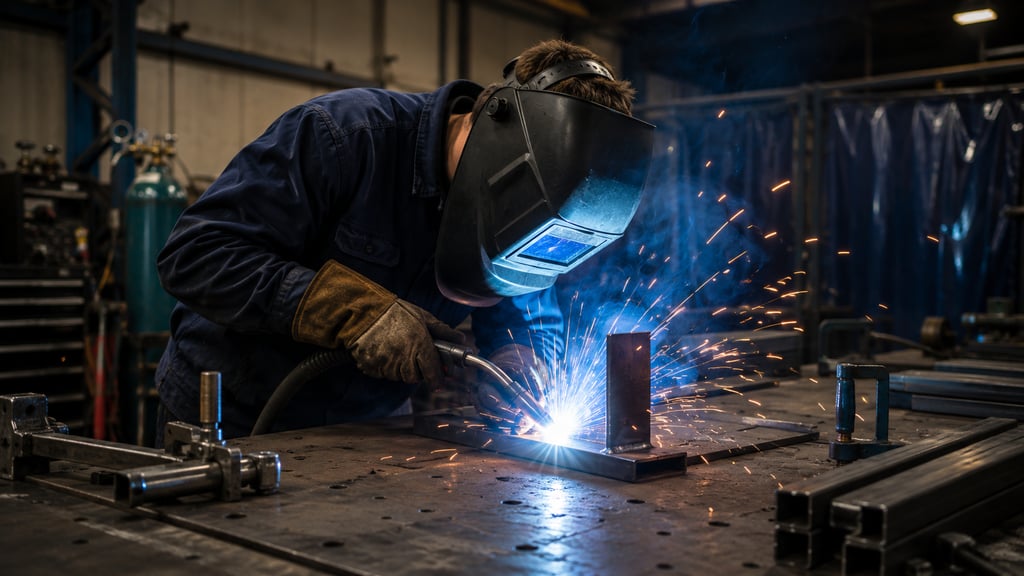
Welders join and cut metal using heat — there are over 100 processes, but the common ones are MIG, TIG, stick, and flux-core. The work spans manufacturing, construction, shipbuilding, energy (pipelines, refineries, wind towers, nuclear), and defense. Some welders run production in a shop; others travel to job sites, refineries, and rigs. It's precise, hands-on, high-focus work — two pieces of steel become one, strong enough to hold up a bridge.
What it pays — the honest version
Here's where you have to read past the headline number. The median wage was $51,000 in May 2024 (BLS), with the top 10% over $75,850. Taken alone, that's a solid middle-class trade, not a flashy one.
But the median badly understates the ceiling, because welding pay is driven by certifications and specialty, not seniority:
Entry-level production welders start around $35,000–$42,000 while building speed and passing basic position tests.
Certified, mid-career welders (AWS certs, a few years in) move into the $45,000–$65,000 range.
Specialists are where it breaks open: a welder certified in all-position and 6G pipe, willing to travel, frequently clears $100,000+ once overtime and per diem are counted. Pipeline, refinery, aerospace TIG, and underwater welders can reach $100,000–$180,000+.
The pattern: every passed test, every specialty cert, every position mastered is measurable money on the next job. Your income tracks your skill, and your skill is entirely in your control.
How to get in without a four-year degree
Do a welding program at a trade school or community college — typically 6 to 18 months. This gets you the fundamentals, safety, and blueprint reading far faster than starting cold.
Get AWS certified. The American Welding Society certification is the industry standard, and certified welders earn meaningfully more than uncertified ones. This is the credential that turns a "helper" into a "welder."
Learn multiple processes — MIG, TIG, stick, flux-core. Versatility raises your rate.
Specialize, then decide your ceiling. Pipeline (6G), pressure vessel (ASME), aerospace TIG, or underwater — each specialty is a pay jump. From there you can become a Certified Welding Inspector (CWI) — an office-based QC role often paying $90,000–$130,000+ — or open your own fabrication shop.
Is it worth it?
Here's the honest outlook, because the surface number is misleading. BLS projects just 2% growth through 2034 — below average. But that stat hides the real opportunity: there are about 45,600 openings every year, and the average working welder is 55 years old. The workforce is retiring faster than it's being replaced. When you're the one filling those openings, "replacement demand" versus "new growth" doesn't matter — the paycheck clears either way, and the shortage gives you leverage.
The honest tradeoffs: it's physical, hot, sometimes uncomfortable work; the entry-level median isn't high; and reaching the big money requires actively stacking certs and often traveling. But few paths offer a sub-18-month on-ramp, a debt-free start, a testable skill no one can take from you, and a six-figure ceiling for those who specialize.
And here's the part school leaves out: in the trades, the skill can become a business you own. A veteran welder can open a fabrication shop and stop trading hours for wages — leveraging the trade into margins instead of an hourly rate. The weld is the seed; the shop is the ceiling.
The principle underneath all of it: the degree was never the thing — the skill is the thing, and in welding, the skill is the proof. Layer the training, stack the certifications, specialize, and if you want it, build the business. That's how sparks turn into a lucrative life.
And even here, lean into AI — a welder who uses tools like ChatGPT or Claude to study for AWS and CWI exams, understand welding codes, and run the books for their own shop will outpace the one who doesn't. AI can't lay a bead in a refinery, but the tradesperson who uses it well runs the smarter business.
If hands-on careers like this are your lane, our guide to the 15 highest-paying jobs without a four-year degree covers more paths built the same way — and you'll find welding among the trades that literally built America.
Ready to map your own path? The Foundational Bundle gives you all three of our core guides plus a workbook: More Paths Than You Think (high-paying careers without a four-year degree), the Post High School Plan (how to build your path step by step), and The AI Guide for Life After High School (how to put AI to work in whatever career you choose). Everything you need to pick a direction, build the skills, and turn them into income — no four-year degree required.
Just want the career roadmap? More Paths Than You Think is available on its own.