Build Experience. Build Skills. Build Direction.

The Trades That Built America (and Still Do)
America was built by skilled hands with no four-year degree — and it's being rebuilt by them right now. On the country's 250th birthday, a look at the trades that made America and the wide-open paths into them today.
CAREERS WITHOUT A COLLEGE DEGREEPOST HIGH SCHOOL PLANNING
Jon & Angela Stoyak
7/4/20264 min read
The Trades That Built America (and Still Do)
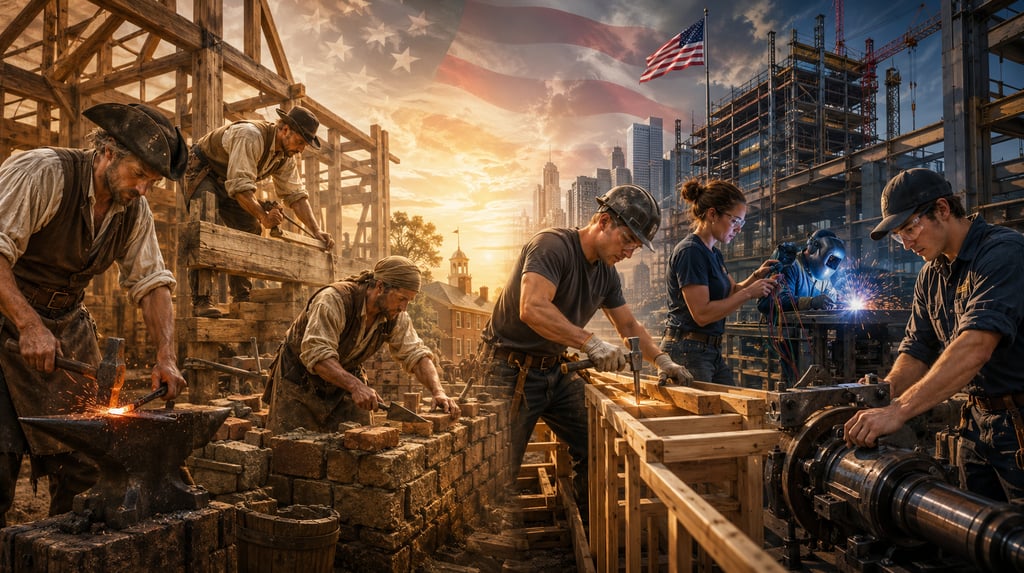
Two hundred and fifty years ago today, a group of people declared that an ordinary person could build something extraordinary. Then they went out and actually did it — not with degrees, but with hands. Blacksmiths, carpenters, masons, millwrights, and mechanics laid the physical country brick by brick, beam by beam. On America's 250th birthday, it's worth remembering a truth we've quietly forgotten: this country was built by skilled hands, it's still standing because of them, and it's being rebuilt by them right now.
First principle: everything you can see was built by someone who knew how
Look around wherever you're sitting. The wiring in the walls, the pipes under the floor, the roads outside, the grid that powers your screen, the building itself — every bit of it exists because a skilled person put it there. Not a theory. Not an app. A person with a trade.
We've drifted into talking about the economy like it's all software and spreadsheets floating in the cloud. But strip that away and the physical truth is unchanged from 1776: a civilization is a physical thing, and physical things are built and maintained by people who know how to build and maintain them. The founders understood this instinctively, because they lived in a world where the person who could build was the person who mattered. That hasn't changed. We just stopped saying it out loud.
Second principle: America's foundation was never a credential — it was capability
Here's the part worth sitting with on the 250th. The people who built this country didn't have four-year degrees. They had apprenticeships, skills passed hand to hand, and the grit to figure it out. Paul Revere was a silversmith. The men who raised the barns, forged the tools, and laid the rail learned by doing. The entire American Dream — the radical idea that where you start doesn't determine where you end — was built on capability, not credentials. You could arrive with nothing, learn a trade, and build a life. That was the promise.
Somewhere in the last fifty years we swapped that story for a narrower one: that the only respectable path runs through a university, and everything else is a fallback. It's worth naming how new and how wrong that idea is. For 200 of these 250 years, the skilled path was the main path — and it built everything the university-first path now takes for granted.
Third principle: the country is being rebuilt right now — and it still runs on trades
This isn't nostalgia. It's the most current story in the economy. America is in the middle of the biggest infrastructure and industrial build-out in generations — data centers for the AI boom, a rewired power grid, new factories, roads and bridges and water systems long overdue. And every bit of it is bottlenecked by the same thing: not enough skilled hands.
The demand is staggering and it's now. Electricians are so scarce that the head of one of the largest companies on earth called the shortage the single biggest thing slowing the AI economy down. Plumbers, HVAC techs, welders, and linemen are retiring faster than they're being replaced, which means the people entering these trades today are walking into decades of work and real leverage. The country that skilled hands built 250 years ago needs skilled hands again — and it's willing to pay for them.
The trades that built it — and where to start
If any of this stirs something in you — or in a kid you're raising who'd rather build than sit — here's the honest good news: these paths are wide open, they pay well, most require no four-year degree, and many can lead to owning your own business. We've written the real, BLS-backed breakdown of each: what the work is, what it pays, and how to get in.
Electrician — wiring the homes, factories, and data centers the whole economy runs on.
Plumber — the urgent, essential trade with one of the clearest paths to business ownership.
HVAC Technician — heating and cooling everything, with a six-month on-ramp and a six-figure ceiling for owners.
Lineman — keeping the power grid alive, storm after storm.
Millwright — the precision problem-solvers who keep industry running.
Welder / NDT Technician — joining and inspecting the steel that holds it all together.
Wind Turbine Technician — the fastest-growing trade in the country, building the next grid.
Every one of these is a link in a chain that runs straight back to the founders: learn a real skill, do honest work, build something that lasts.
The through-line, 250 years running
Here's what hasn't changed in two and a half centuries: this country rewards people who can do things. The tools got more advanced — today's electrician troubleshoots computerized systems, today's welder works to tolerances the founders couldn't imagine — but the principle is identical. Skill plus effort builds a life. A degree was never the thing; the capability was always the thing.
That's the real American Dream, and it's as available today as it was in 1776. Layer a genuine skill, education of any kind, and daily effort, and you build a lucrative life — and maybe, like the people we're celebrating today, you help build the country while you're at it.
Happy 250th, America. Built by hands. Still standing because of them.
Ready to find your path? The Foundational Bundle gives you all three of our core guides plus a workbook: More Paths Than You Think (the high-paying careers — trades and beyond — that don't require a four-year degree), the Post High School Plan (how to build your path step by step), and The AI Guide for Life After High School (how to put AI to work in whatever you choose). Everything you need to pick a direction, build the skills, and turn them into income.
Just want the career roadmap? More Paths Than You Think is available on its own.