Build Experience. Build Skills. Build Direction.
How to Become a Truck Driver (CDL Class B) Without a Four-Year Degree
A CDL Class B gets you driving box trucks, buses, and dump trucks — local, home-every-night work with no four-year degree and a short training path. Here's the honest pay and how it differs from Class A.
CAREERS WITHOUT A COLLEGE DEGREEPOST HIGH SCHOOL PLANNING
Jon & Angela Stoyak
7/18/20265 min read
How to Become a Truck Driver (CDL Class B) Without a Four-Year Degree
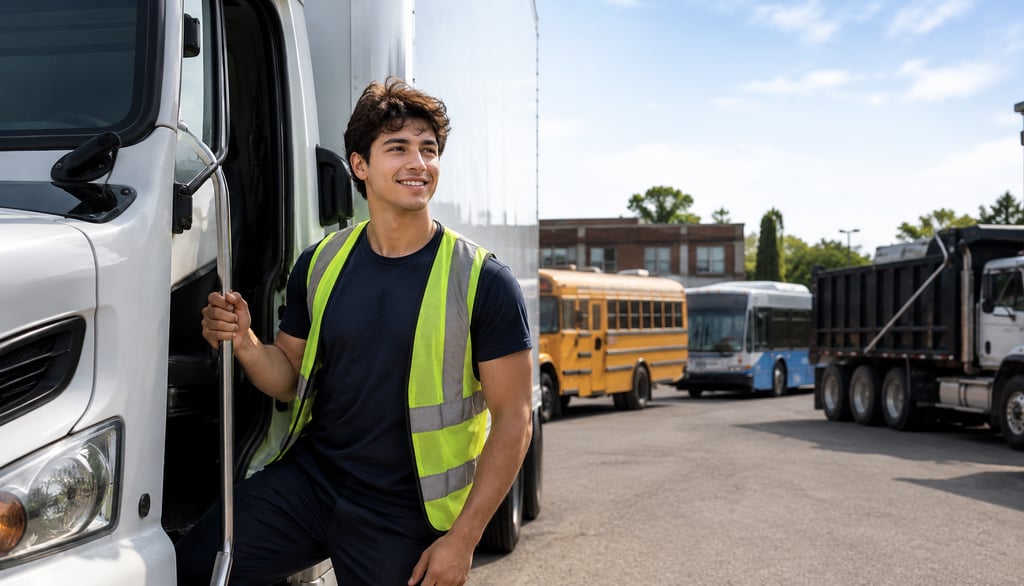
There's a whole category of driving jobs that pay a real wage, keep you home every night, and take only weeks to train for — no four-year degree, and no life on the open highway. It's the world of the CDL Class B driver: the box trucks, buses, dump trucks, and delivery vehicles that keep your own town running. Most people lump all "truck driving" together, but Class B is its own distinct path, and for a lot of people it's the better fit. Let's look at what the work is, what it honestly pays, and how it differs from the long-haul Class A route.
Note: this post is about the CDL Class B license — local, straight-truck, and passenger driving. If you're picturing tractor-trailers and cross-country freight, that's the Class A path, and we cover it in our separate guide on how to become a Class A truck driver.
First principle: staying local is a feature, not a lesser version
There's a quiet assumption that the "real" trucking job is the long-haul one, and everything else is a step down. Flip that around. For a lot of people — especially anyone with a family, a hometown they love, or a life outside work they want to keep — being home every single night isn't the consolation prize. It's the whole point. Class B driving is built around local and regional work: you run your route, you clock out, you sleep in your own bed. That's a genuine advantage, not a compromise.
Strip it down: the best career isn't the one with the biggest number on paper — it's the one that fits the life you actually want to live. For many people, a solid local wage with your evenings intact beats a bigger long-haul paycheck earned from a truck cab three weeks a month.
Second principle: a shorter, cheaper on-ramp is worth taking seriously
Here's the assumption worth breaking. We tend to dismiss anything that trains fast as somehow lesser. But a Class B CDL can have you licensed and earning in a matter of weeks, often for less time and money than a Class A program, and it opens the door to steady, essential local work. That fast, affordable on-ramp — with little or no debt — is exactly what makes it valuable for someone who needs to start earning soon. Quick to enter doesn't mean low quality; it means low barrier.
What the job actually is
A CDL Class B license lets you operate a single heavy vehicle (over 26,000 pounds) that isn't pulling a large trailer. That covers a wide and surprisingly varied set of jobs: driving a city or transit bus, a school bus, a dump truck on construction sites, a garbage or recycling truck, a delivery box truck, a cement mixer, or a passenger shuttle. Most of this work is local or regional, tied to a route or a job site, with predictable daily hours. It's a good fit for someone who wants steady, hands-on work close to home and likes being out and about rather than behind a desk.
Curious what other careers fit this same "short path, essential work" pattern? Our guide to the 15 highest-paying jobs without a four-year degree lays out more of them.
What it pays
Class B pay depends heavily on which Class B job you take, so here's the honest picture rather than one tidy number. Local delivery driving sits at the lower end — the BLS median for light truck drivers was $44,140 in May 2024 — while dump-truck, specialized, and especially bus-driving roles tend to pay more, with transit and intercity bus driver medians running higher than delivery work (worth checking for the specific role and region you're targeting).
The honest framing: Class B generally starts below the long-haul Class A median, and that's the real tradeoff for staying local and home every night. But the number isn't fixed. Endorsements move it — a passenger (P) or school bus (S) endorsement opens bus driving, and a HazMat (H) endorsement opens higher-paying specialized routes. Union positions (common in transit, sanitation, and municipal jobs) often come with strong pay, benefits, and pensions that raise the real value well above the base wage. And public-sector Class B jobs — city bus, school district, municipal work — frequently carry benefits that a raw salary number doesn't capture.
How to get in without a four-year degree
Finish high school or earn a GED. A clean driving record and the ability to pass a DOT physical and drug screening matter most at the start.
Get your Class B CDL. Attend a training program — often shorter than a Class A course — to earn your license. Some employers, especially transit agencies, school districts, and municipalities, will train you or pay for your CDL in exchange for a work commitment.
Add the right endorsements. Match them to the job you want: Passenger (P) and School Bus (S) for bus driving, HazMat (H) for specialized freight, Air Brakes as needed. Each endorsement opens a different set of roles.
Get hired and choose your lane. Bus driver, dump truck operator, delivery driver, sanitation, shuttle — pick the setting that fits your life, then build seniority. Public-sector and union routes especially reward sticking around with raises, benefits, and security.
You can be licensed and earning locally in weeks — with little or no training debt, and home every night.
Is it worth it?
The outlook is genuinely strong on the local-delivery side: BLS projects delivery truck driver and driver/sales employment to grow 8% through 2034 — much faster than average — with about 171,400 openings a year, driven heavily by the growth of e-commerce and last-mile delivery. Bus driving and municipal roles add steady public-sector demand on top of that. Getting hired is rarely the obstacle.
The honest tradeoffs: Class B typically pays less than long-haul Class A, so if maximizing income is the only goal, Class A (or stacking up to it later) may fit better. The work is physical — loading, lifting, in and out of the cab all day — and some roles (sanitation, construction) are tougher on the body than others. Bus driving comes with the real responsibility of passenger safety and, for school routes, managing kids. But for essential, steady, local work with a fast on-ramp and your evenings kept intact, Class B is one of the most life-friendly no-degree paths out there. And it's a natural stepping stone — many drivers start with Class B and add Class A later if they decide to.
The principle underneath it all: the degree was never the thing — the skill and the license are the thing. You don't need four years to hold a job your town depends on. Earn the Class B CDL, add the right endorsements, drive safely, add daily effort, and you build a stable, meaningful career without ever leaving home overnight.
Ready to map your own path? The Foundational Bundle gives you all three of our core guides plus a workbook: More Paths Than You Think (high-paying careers without a four-year degree), the Post High School Plan (how to build your path step by step), and The AI Guide for Life After High School (how to put AI to work in whatever career you choose). Everything you need to pick a direction, build the skills, and turn them into income — no four-year degree required.
Just want the career roadmap? More Paths Than You Think is available on its own.