Build Experience. Build Skills. Build Direction.
The Workforce Pell Grant Starts July 2026 — Free Money for Job Training, Explained
The new Workforce Pell Grant starts July 2026 — federal money you don't repay, now covering short-term job training for the first time ever. Here's exactly what it covers, the honest award amount, and how to get it in your state.
POST HIGH SCHOOL PLANNINGCAREER EXPLORATIONCAREER DISCOVERY
Jon & Angela Stoyak
6/27/20265 min read
The Workforce Pell Grant Starts July 2026 — Free Money for Job Training, Explained
For sixty years, the federal government had a clear message baked into how it gave out college money: we'll help you pay for a four-year degree, but if you want to learn a skill — fast, hands-on, the kind that gets you hired in a few months — you're on your own. That message just changed. And almost nobody's talking about it yet.
Let's break down what actually happened, because once you understand the principle underneath it, you'll see why this matters more than the headline suggests.
First principle: follow what the government decides to pay for
Money reveals priorities. For decades, federal student aid pointed in exactly one direction — the traditional degree — and a whole generation absorbed the lesson that the degree was the path, because it was the only path with funding behind it. The skill-based route existed, but you paid for it yourself, which quietly told everyone it was the lesser option.
Strip that down and here's the truth that was always sitting underneath: a degree was never the thing that made you employable. The skill was the thing. The degree was one expensive, slow way to package a skill — and for a huge number of good careers, it was never the right package at all. The funding just made it look that way.
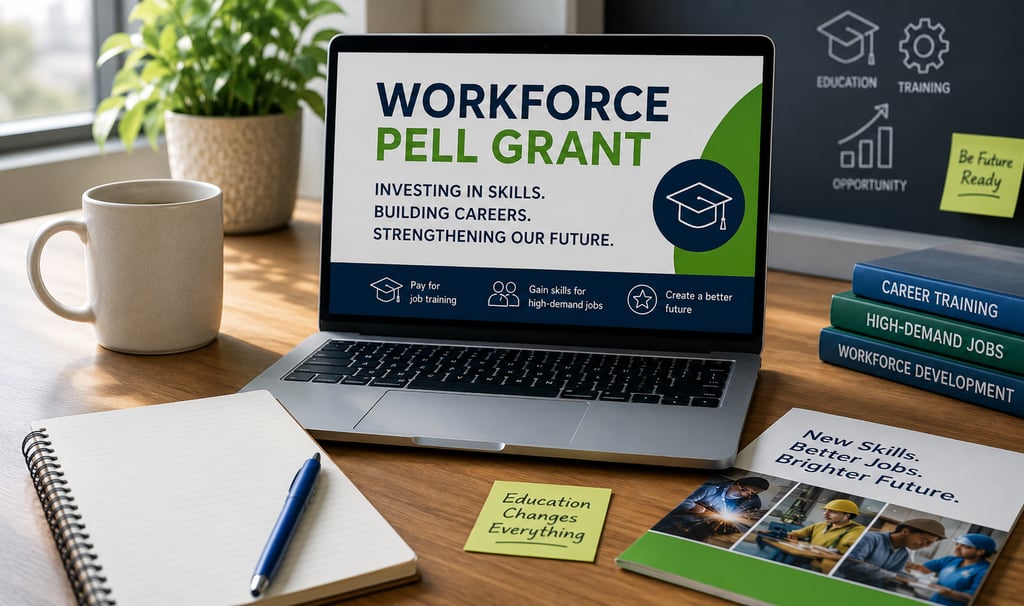
Workforce Pell flips the signal. Beginning July 1, 2026, students can receive Pell Grants for short-term educational programs that prepare them for high-skill, high-wage, and in-demand jobs. The federal government is now putting real money behind the exact paths we've always talked about here — the fast, skill-first routes that don't require four years and a mountain of debt. When the money moves, pay attention. It's telling you something true. GoTu
What it actually is
Workforce Pell extends the Pell Grant — federal aid you do not pay back — to short-term job training for the first time in the program's history. It was created under the Working Families Tax Cuts Act, signed into law on July 4, 2025, and the Department of Education published the final rule on May 19, 2026. GoTuU.S. Bureau of Labor Statistics
The specifics, verified against the federal rule:
Program length: Between 150 and 599 clock hours, which works out to roughly 8 to 15 weeks of instruction. Some programs can be completed in as little as 8 weeks. U.S. Bureau of Labor Statistics + 2
Fields covered: Information technology, healthcare, vehicle operation, skilled trades, and early childhood education — with manufacturing, transportation, and public safety in the mix too. CourseraU.S. Bureau of Labor Statistics
It's for aid you don't repay. This is a grant, not a loan. That distinction is the whole point.
The two details almost no one is reporting (and they're the best part)
Here's where being early pays off, because these two facts barely made the news and they're enormous for the people we talk to.
You can use it even if you already have a four-year degree. Students who already hold a bachelor's degree can receive a Workforce Pell Grant — a change from traditional Pell rules. (The one exclusion: no graduate students or graduate-degree holders.) Think about who that helps — every adult who got the degree, didn't find the career, and wants to pivot into a trade or a healthcare role without paying out of pocket. The door is open to them now too. Harper CollegeHarper College
Apprenticeships count. Related technical instruction tied to a Registered Apprenticeship is treated as meeting the high-skill requirement. The earn-while-you-learn path we keep pointing people toward can now be supported by grant money. Harper College
What it pays — the honest number
This is where you have to be careful, because it's easy to get oversold. The maximum Pell Grant for the 2026–27 award year is $7,395. But — and this matters — Workforce Pell awards will typically run smaller, because the program length and clock-hour caps drive proration. The Congressional Budget Office projects an average grant of around $2,200. UTI + 2
So the truthful framing: think a couple thousand dollars on average, up to $7,395 in the best cases — money you never repay, applied to training that's already cheap and short to begin with. For a program that gets you working in 8 to 15 weeks, that can cover a huge chunk, sometimes all of it. Anyone promising you a flat $7,395 check for a short program doesn't understand how the proration works.
How to actually get it
The mechanics run through a system you may already know:
File the FAFSA. The process starts with the Free Application for Federal Student Aid and requires enrollment in an approved program. It's free, at StudentAid.gov. FAFSA filing is still required — there's no shortcut around it. U.S. Bureau of Labor StatisticsHarper College
Find an approved program in your state. This is the critical step (more below).
Enroll and verify. Once you're accepted, your school confirms eligibility and disburses the funds. U.S. Bureau of Labor Statistics
The honest catch: "available July 2026" doesn't mean "available everywhere, day one"
Here's the part that protects you from disappointment, and it's the most important thing in this whole article. The launch is real, but the rollout is staggered by state.
While the program's provisions are generally effective July 20, 2026, the Department allows optional early implementation beginning July 1, 2026, at each institution's discretion. More importantly: states must still establish approval processes, define eligible occupations, determine eligible programs, and coordinate across their workforce and higher-education systems. There's no guarantee that programs will be ready to enroll students on day one. Jobincome360 + 2
Why the holdup? The accountability bar is genuinely high — which is a good thing for you, because it filters out junk programs. To qualify, a program must be approved by the governor, demonstrate at least a 70% completion rate and 70% job placement within six months, and prove that its tuition doesn't exceed the earnings students actually gain. Each state's governor must approve the eligible programs. States like Iowa already opened their institutional applications back in April; others are moving at their own pace. Jobincome360U.S. Bureau of Labor Statistics
So the realistic move isn't "show up July 1 and grab a check." It's: file your FAFSA now, then check what's actually approved in your state — your state's education or workforce-development department is where that list will live, and it'll grow through the summer and fall.
Is it worth paying attention to? Absolutely.
For decades the system funded one path and made everyone feel the others were second-best. That's over. The federal government just put grant money — the kind you never repay — behind exactly the kind of fast, skill-first, get-to-work training that builds a real life without a four-year degree or the debt that comes with it.
The principle worth carrying out of this: the degree was never the thing. The skill is the thing. And now, for the first time, the money agrees. Layer a real skill, a low-cost credential, and daily effort — and you build a lucrative life. The funding just caught up to what was always true.
If you want to see the kinds of careers this grant is built to fund, our guide to the 15 highest-paying jobs without a four-year degree walks through paths exactly like these — many of them trainable in the same short, skill-first programs Workforce Pell is designed for.
Ready to map your own path? The Foundational Bundle gives you all three of our core guides plus a workbook: More Paths Than You Think (high-paying careers without a four-year degree), the Post High School Plan (how to actually build your path step by step), and The AI Guide for Life After High School (how to put AI to work in whatever career you choose). Everything you need to pick a direction, build the skills, and turn them into income — no four-year degree required.