Build Experience. Build Skills. Build Direction.

How to Become an HVAC Technician Without a Four-Year Degree
That neighbor with three trucks and no degree learned a skill the world can't live without. Here's how to become an HVAC tech — the real path, the real pay, and why it starts in months, not years.
CAREERS WITHOUT A COLLEGE DEGREEPOST HIGH SCHOOL PLANNING
Jon & Angela Stoyak
6/27/20264 min read
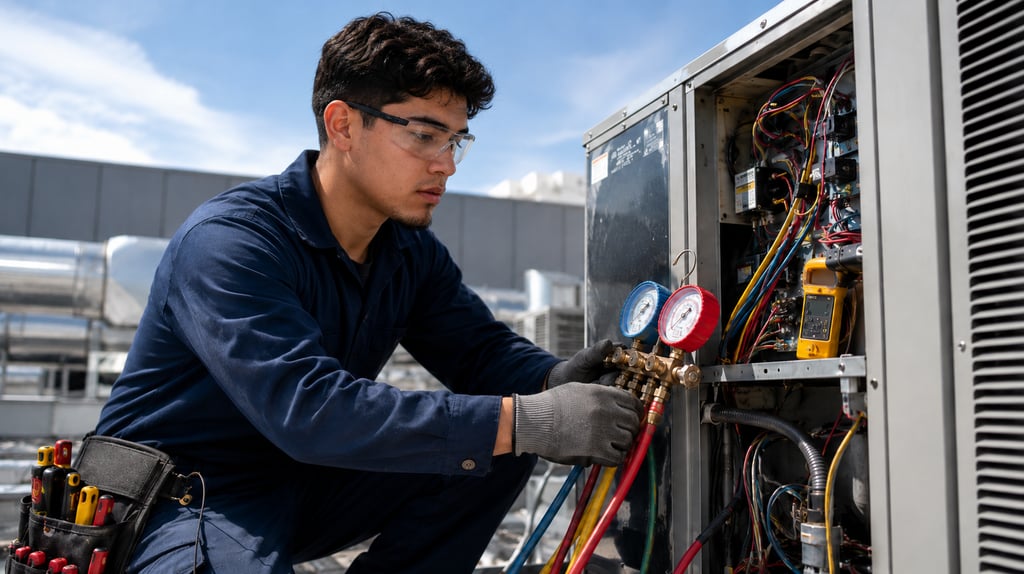
How to Become an HVAC Technician Without a Four-Year Degree
You know that guy from your high school class who now owns three trucks and a house, takes his family to Disney every year, and never sat through a single college lecture? You assumed he got lucky, or knew somebody. He didn't. He learned a skill the world can't function without — and he started while everyone else was taking out loans.
Let's take this all the way down to what's actually true, because once you see it, you can't unsee it.
First principle: money comes from solving a problem people can't solve themselves. Not from a diploma. A diploma is a signal that you might be able to solve problems — but the market doesn't pay the signal, it pays the solving. We've been taught to chase the signal and assume the money follows. Strip that away and the real question appears: what problem can I solve that people will always pay for?
Second principle: the most durable problems are physical and local. A problem that can't be shipped overseas, can't be automated, and has to be fixed today, in this building, by a human standing in front of it — that's a problem with pricing power forever. When your AC dies in July, you don't care about anyone's degree. You care about the one person who can make it cold again, and you will pay them whatever they ask.
That person is an HVAC technician. Heating, cooling, and refrigeration touch every home, hospital, school, store, and data center in the country. The systems break. They always break. And somebody has to be qualified to fix them. That's not a job — it's leverage.
What the job actually is
HVAC techs install, maintain, and repair heating, ventilation, air conditioning, and refrigeration systems. Modern systems are computerized and networked, so the work is as much diagnostics and electronics as it is wrenches and refrigerant. You work in homes, businesses, and increasingly in the massive climate-controlled data centers that AI runs on. Some days are installs; some are emergency repairs where you're the hero who shows up.
What it pays
The median wage was $59,810 in May 2024 (BLS), with the top 10% clearing $91,020. But the median undersells the ceiling. Specialists in commercial and industrial refrigeration, techs who earn NATE certification, and — above all — those who start their own company routinely pass six figures. The guy with three trucks isn't an outlier; he's the predictable end of the path.
How to get in without a four-year degree
This is the part nobody told you: the on-ramp is months, not years.
Do a trade-school or community-college HVAC program — typically 6 to 12 months — or enter an apprenticeship and earn from day one.
Get your EPA Section 608 certification. It's federally required to handle refrigerant and it's the credential that moves you from helper to earner.
Build hours and add NATE certification to raise your value and your rate.
Eventually, go out on your own. This is where the math breaks open — the owner keeps the margin, not just the wage.
There's a nationwide shortage of over 110,000 technicians right now. The door isn't just open — they're pulling people through it.
Is it worth it?
The field is projected to grow 8% through 2034 with about 40,100 openings a year. Demand can't be offshored, it can't be automated, and it grows every time someone builds a house or a data center. The honest tradeoffs: you'll work some hot attics, some cold roofs, and some on-call nights, especially early. But you'll be earning in under a year, debt-free, building toward something you can own.
Here's the principle worth carrying out of this: the four-year degree was never the thing. The skill is the thing. The degree is just one slow, expensive way to package a skill — and for this work, it's not even the right package. Layer a real skill, the right certifications, and daily effort, and you build a lucrative life. That's the whole game.
And here's the part that changes everything: in the trades, the skill is the seed of a business. Plenty of HVAC techs spend a few years learning on someone else's payroll, then buy a truck, get their contractor's license, and start keeping the full margin instead of an hourly wage. That guy with three trucks didn't get a raise — he became the owner. The trade is what makes that possible, and it's open to anyone willing to build it.
And whatever path you choose, learn to work alongside AI while you're at it. An HVAC tech who uses tools like ChatGPT or Claude to study for the EPA exam, troubleshoot unfamiliar systems, and eventually run the books for their own company has an edge over one who doesn't. AI won't braze a line set — but the people who use it well will run better businesses.
If hands-on careers like this are your lane, our guide to the 15 highest-paying jobs without a four-year degree covers more paths built the same way.
Ready to map your own path? The Foundational Bundle gives you all three of our core guides plus a workbook: More Paths Than You Think (high-paying careers without a four-year degree), the Post High School Plan (how to actually build your path step by step), and The AI Guide for Life After High School (how to put AI to work in whatever career you choose). Everything you need to pick a direction, build the skills, and turn them into income — no four-year degree required.
Just want the career roadmap? More Paths Than You Think is available on its own.