Build Experience. Build Skills. Build Direction.

How to Become an Elevator Mechanic Without a Four-Year Degree
Elevator mechanics earn a six-figure median with no four-year degree and no student debt. Here's what the job involves, what it pays, and how to get into the apprenticeship that starts paying from day one.
CAREERS WITHOUT A COLLEGE DEGREEPOST HIGH SCHOOL PLANNING
Jon & Angela Stoyak
6/21/20263 min read

How to Become an Elevator Mechanic Without a Four-Year Degree
Most people only think about elevators when they're stuck in one. But the small group of people who install and repair them quietly hold one of the highest-paying skilled trades in the country — and you can get in with a high school diploma, no four-year degree, and zero student debt. Here's how the job works, what it pays, and how to get started.
What an elevator mechanic actually does
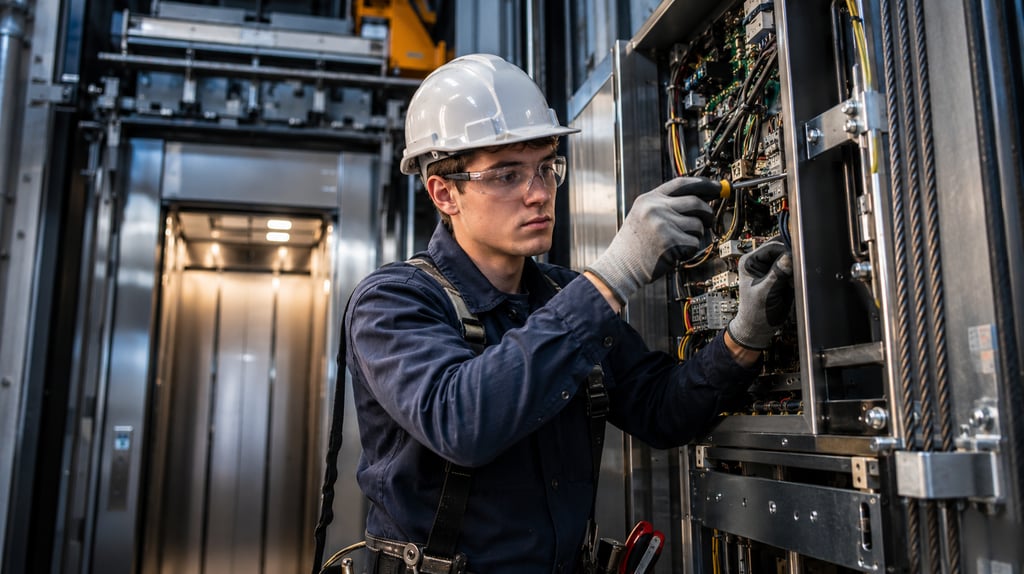
Elevator and escalator installers and repairers assemble, install, maintain, and fix elevators, escalators, moving walkways, and lifts. That covers everything from wiring a brand-new system in a high-rise under construction to troubleshooting a computerized control board, doing scheduled maintenance, and responding when something breaks down.
It's a blend of skills most trades keep separate: electrical work, mechanical repair, blueprint reading, and real-time problem-solving. Modern elevators run on computerized controls and energy-efficient drives, so the work has gotten more technical, not less — you're as likely to be diagnosing software-driven systems as turning a wrench. The job often means working at heights and in confined spaces, and many mechanics are on call for emergency repairs.
There's a reason the pay holds up: this is work that can't be automated away or shipped overseas. Every building with an elevator is legally required to keep it safe, inspected, and running — which means steady, must-do demand that doesn't ride on trends.
What it pays
This is the headline. The median annual wage for elevator and escalator installers and repairers was $106,580 in May 2024, according to the Bureau of Labor Statistics — more than double the $49,500 median for all U.S. workers.
A few things to know about how the pay builds:
Apprentices start at roughly half the fully-trained rate and earn scheduled raises as they progress — so you're paid from day one, not after.
Certified welders earn higher wages while welding during their apprenticeship.
Overtime, on-call premiums, and modernization projects push experienced mechanics in busy metro areas well past the median, often into the $130,000–$150,000 range.
You earn while you train, and you finish with no degree debt.
How to get in without a four-year degree
The path is well-defined, and it starts with a high school diploma or equivalent. Classes in math, physics, and mechanical drawing help but aren't required.
Apply to an apprenticeship. Nearly everyone enters through a roughly four-year apprenticeship sponsored by a union, industry association, or employer. These are competitive, so apply broadly. (The U.S. Department of Labor's apprenticeship finder is a free place to start.)
Earn while you learn. Each year combines required classroom hours — safety, blueprint reading, electrical and digital theory, applied physics, equipment design — with paid on-the-job training under a working mechanic.
Pass the Mechanic Exam. Finishing the apprenticeship makes you eligible to sit for it. Passing makes you a journeyman mechanic, and that's when your pay jumps to the full rate.
Get licensed. Most states require a license, and requirements vary — check your state's licensing board. Optional certifications (like the Certified Elevator Technician credential) can demonstrate added proficiency.
If you can document relevant prior experience, you may qualify for a shorter apprenticeship.
Is it worth it?
For the right person, this is one of the strongest no-degree careers out there. The trade is projected to grow 5% from 2024 to 2034 — faster than average — with about 2,000 openings every year. Most of those openings aren't from new construction; they come from an aging workforce retiring and taking decades of experience with them. Few young people even consider the trade, which keeps the talent pool small and the leverage on your side.
The honest tradeoffs: the apprenticeship is a multi-year commitment, the work demands comfort with heights and confined spaces, and on-call rotations are part of the deal. But if you're mechanically inclined, like solving concrete problems, and want six-figure earning potential without a classroom degree, few trades pay this well for the barrier to entry.
It comes back to the same principle we return to again and again: layer skills, hands-on training of any kind, and daily effort, and you build a lucrative life — no four-year degree required.
If hands-on trades like this one are your lane, our guide to the 15 Highest-Paying Jobs Without a 4-Year Degree (2026 Salaries) | Cut River Farm covers more careers built the same way — skill and certification over classroom time.
Ready to map your own path? The The Post High School Plan — A Practical Guide to Skill, Savings & Real-World Experience | Cut River Farm walks you step by step through choosing a direction, building real skills, and turning them into income — no four-year degree required.