Build Experience. Build Skills. Build Direction.
How to Become an Aircraft Mechanic (A&P) Without a Four-Year Degree
In aviation maintenance, the A&P license is the credential — no four-year degree, and specialists clear $120K+. Here's the honest pay, the FAA certification path, and the sub-two-year route from trade school to the hangar.
CAREERS WITHOUT A COLLEGE DEGREEPOST HIGH SCHOOL PLANNING
Jon & Angela Stoyak
7/8/20264 min read

How to Become an Aircraft Mechanic (A&P) Without a Four-Year Degree
There's a job where you're the last person to sign off on a machine before it carries hundreds of people into the sky — and you can train for it in about two years, with no four-year degree and no pilot's license. It's called an aircraft mechanic, and the country is short thousands of them right now. Let's look at what the work is, what it pays, and why the path is so much shorter than the responsibility suggests.
First principle: the flight doesn't happen without the person nobody pictures
Picture a flight. You picture the pilot. Maybe the flight attendants. You almost certainly don't picture the person in the hangar at 4 a.m. who ran the inspection, traced a fault through the electrical system, and signed the logbook that legally cleared that aircraft to fly. But that flight does not leave the gate without that person. The airline cannot operate the plane until they say it's airworthy.
Strip it down: value doesn't come from being the most visible person on the aircraft. It comes from being the person the aircraft can't leave without. The mechanic is invisible to the passengers and indispensable to the airline — and indispensable is what pays, and what lasts.
Second principle: enormous responsibility and a long expensive path are not the same thing
Here's the assumption worth breaking. We see "signs off on whether a plane is safe to fly" and our brain fills in "so that must take a decade and a fortune." It doesn't. An aircraft mechanic trains in roughly 18 to 24 months — an FAA-approved program and a certificate — not the years a pilot spends building hours or an engineer spends in a degree. The responsibility is real and serious. The on-ramp is short. We just assume the two always travel together, and they don't. Once you separate the weight of the work from the length of the schooling, a door most people walk right past swings open.
What the job actually is
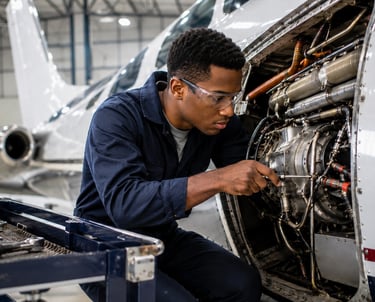
Aircraft mechanics — often called A&P mechanics, for the Airframe and Powerplant certification most of them hold — inspect, repair, and maintain planes and helicopters. That means diagnosing engine trouble, fixing hydraulic and electrical systems, replacing worn parts, and running the detailed inspections that keep an aircraft legally cleared to fly. A related specialty, the avionics technician, focuses on the electronic side: navigation, communication, and the increasingly computerized cockpit. It's hands-on, detail-obsessed, high-stakes work for people who stay careful and focused when it counts.
Curious what other careers fit this same "short path, serious responsibility" pattern? Our guide to the 15 highest-paying jobs without a four-year degree lays out more of them.
What it pays
The median annual wage for aircraft mechanics and service technicians was $78,680 in May 2024 (BLS) — well above the $49,500 median for all workers. The honest spread is what matters most: the lowest 10% earned under about $47,790, and the top 10% earned more than $120,080. Avionics technicians run slightly higher, with a median of $81,390.
And the ceiling climbs past the BLS median for those who specialize. Total compensation at a major cargo carrier can reach past $155,000 at top scale, and corporate and business aviation mechanics often out-earn commercial ones once everything is counted, with base pay commonly $85K–$120K. That range isn't random — it tracks certification, specialty, employer, and location. New techs typically start in the $40,000s and climb steadily as they certify and add ratings.
How to get in without a four-year degree
Finish high school. Strong math, physics, and shop skills give you a real head start.
Complete an FAA-approved program. Most people attend an FAA-approved Aviation Maintenance Technician School — a "Part 147" program — running about 18 to 24 months and covering both airframe and powerplant systems. Military aviation training or documented supervised experience are alternate routes.
Earn your FAA A&P certificate. This means passing written, oral, and practical exams. The A&P license is the credential that unlocks the well-paying jobs — it's the whole ballgame.
Get hired and specialize. Once you're working, stack credentials: avionics, Inspection Authorization (IA), or manufacturer-specific type training. Each one raises your rate.
You can be signing off on aircraft, earning a stable skilled-trade income, in about the time it takes to finish two years of a four-year degree — and with no tuition debt hanging over you.
Is it worth it?
The field is projected to grow 5% through 2034 — faster than average — with about 13,100 openings a year. But the number underneath that is the real story: the workforce is aging out fast, roughly a third of aviation maintenance school seats sit unfilled, and the global fleet keeps growing. That's a shortage the industry can't fill quickly, which means leverage for anyone who trains now.
The honest tradeoffs: it's physical work, shifts can mean nights, weekends, and holidays, and getting certified costs real money and time upfront. But for an 18-to-24-month on-ramp into essential, well-paid, hands-on work that most people never even consider, few paths match it.
The principle underneath it all: the degree was never the thing — the skill and the credential are the thing. You don't need four years to hold a job an airline depends on. Layer the accredited program, earn the A&P, add daily effort, and you build a stable, meaningful, well-paid life.
Ready to map your own path?
The Foundational Bundle gives you all three of our core guides plus a workbook: More Paths Than You Think (high-paying careers without a four-year degree), the Post High School Plan (how to build your path step by step), and The AI Guide for Life After High School (how to put AI to work in whatever career you choose). Everything you need to pick a direction, build the skills, and turn them into income — no four-year degree required.
Just want the career roadmap? More Paths Than You Think is available on its own.