Build Experience. Build Skills. Build Direction.

How to Become a Plumber Without a Four-Year Degree
A self-employed master plumber can clear $150K+ — with no tuition, because the apprenticeship pays you. Here's the honest path from apprentice to business owner, and why the trade is the on-ramp.
CAREERS WITHOUT A COLLEGE DEGREEPOST HIGH SCHOOL PLANNING
Jon & Angela Stoyak
7/2/20264 min read
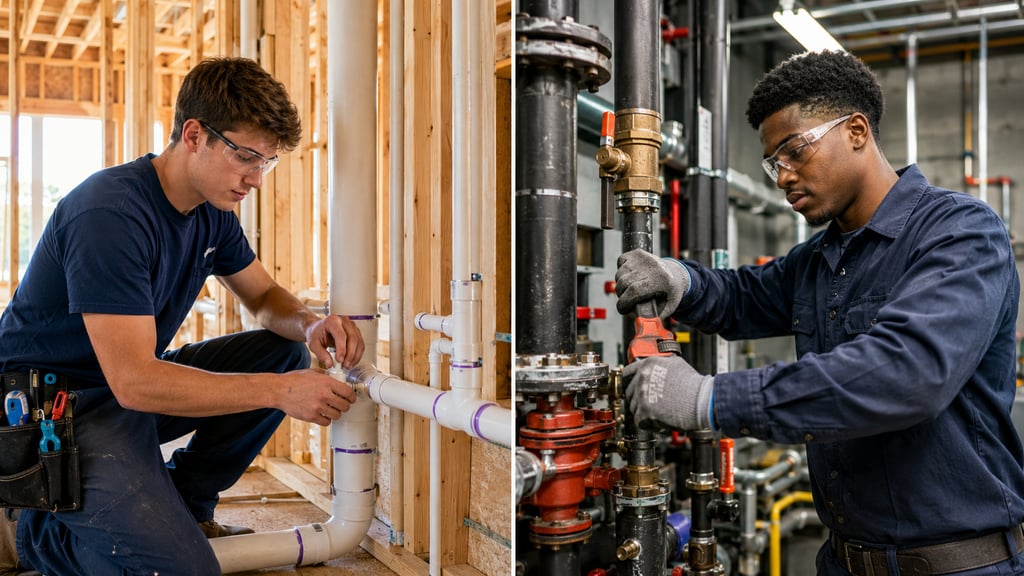
How to Become a Plumber Without a Four-Year Degree
Here's a number that stops people: a self-employed master plumber can clear $150,000 to $200,000 a year. Not a journeyman on wages — the one who owns the business. And the path to get there costs no tuition, because they pay you to learn it. Plumbing is one of the clearest examples of a truth nobody explained to you in high school: a trade isn't just a job. It's the on-ramp to owning the business.
First principle: a problem that's urgent, physical, and local has permanent pricing power
When a pipe bursts at 9 p.m. and water is pouring through the ceiling, the homeowner does not care about anyone's degree. They care about one thing: who can make it stop, right now. That urgency is the entire economic engine of the trades. The problem can't wait, can't be shipped overseas, can't be handled by an app, and has to be solved by a skilled human physically standing in the house. That combination — urgent, physical, local — is about as much pricing power as any worker can have.
Strip it down: money follows the ability to solve a problem people can't solve themselves and can't postpone. Plumbing is that, in its purest form.
Second principle: in the trades, the skill is the seed of a business
This is the part that changes everything, and it's the part school never mentions. In a lot of careers, the ceiling is your salary — you trade hours for a wage, and someone above you keeps the profit. In the trades, the skill is a business waiting to be started. You learn on someone's payroll, then at some point the math flips: you get licensed, buy a truck, hang your own name, and start keeping the full margin instead of an hourly rate. The plumber with three vans didn't get a raise. He became the owner. The trade made it possible.
What the job actually is
Plumbers install and repair the water, drainage, and gas systems in homes, businesses, and industry — from new construction to the emergency call at midnight. It's skilled, code-governed, problem-solving work, and it's licensed, which protects wages by keeping the field to people who actually know what they're doing.
What it pays
The median wage was $62,970 in May 2024 (BLS), with the top 10% over $105,150. But the median describes the employed middle of the trade, and the real story is the ladder:
Apprentices earn while they learn — starting around 40–50% of journeyman pay, with raises as they progress.
Journeymen (licensed, independent) settle into the solid middle and above.
Master plumbers on payroll commonly reach $85,000–$130,000.
Self-employed master plumbers — the business owners — routinely reach $120,000–$220,000+.
The single biggest variable isn't experience. It's whether you own the business or work in someone else's.
How to get in without a four-year degree
Consider a vocational or trade-school program first — not required, but it teaches fundamentals and codes and makes you more competitive.
Enter an apprenticeship — typically 4–5 years, combining paid on-the-job training with classroom instruction. You earn from day one; there's no tuition bill.
Pass your journeyman licensing exam to work independently and pull permits.
Earn your master license, then go out on your own. This is where the ownership math opens up — and it's the whole reason the trade rewards patience.
Is it worth it?
Employment is projected to grow 4% through 2034 with about 44,000 openings every year — and a large share of the current workforce is nearing retirement, which tightens supply and pushes wages up for everyone coming in. The honest tradeoffs: it's physical, it involves tight spaces and weather and the occasional unpleasant job, and you'll be on call for emergencies early on. But few paths combine a debt-free on-ramp, licensed wage protection, and a genuine road to business ownership like plumbing does.
The principle underneath all of it: the degree was never the thing — the skill is the thing, and in the trades, the skill becomes something you can own. Layer the apprenticeship, earn the license, and if you want it, build the business. That's how a trade turns into a lucrative life.
And even here, lean into AI — the plumber who uses tools like ChatGPT or Claude to study for the master exam, write estimates, and run the books for their own company will out-earn the one who doesn't. AI won't sweat a copper joint, but the tradesperson who uses it well runs the better business.
If hands-on careers like this are your lane, our guide to the 15 highest-paying jobs without a four-year degree covers more paths built the same way.
Ready to map your own path? The Foundational Bundle gives you all three of our core guides plus a workbook: More Paths Than You Think (high-paying careers without a four-year degree), the Post High School Plan (how to build your path step by step), and The AI Guide for Life After High School (how to put AI to work in whatever career you choose). Everything you need to pick a direction, build the skills, and turn them into income — no four-year degree required.
Just want the career roadmap? More Paths Than You Think is available on its own.