Build Experience. Build Skills. Build Direction.

How to Become a Diesel Mechanic Without a Four-Year Degree
In diesel, certification and specialty are the credential — no four-year degree, and master techs clear $100K+ with overtime. Here's the honest pay, the ASE ladder, and the under-one-year path into the shop.
CAREERS WITHOUT A COLLEGE DEGREEPOST HIGH SCHOOL PLANNING
Jon & Angela Stoyak
7/9/20264 min read
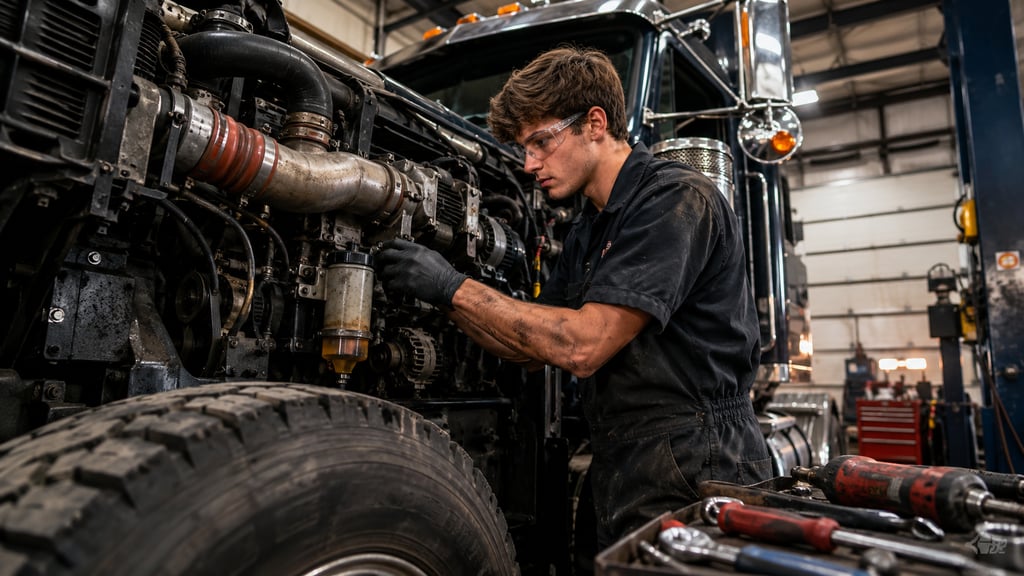
How to Become a Diesel Mechanic Without a Four-Year Degree
There's a job where the entire economy stops moving the moment you stop showing up — every truck hauling freight, every bus, every piece of heavy equipment runs on an engine somebody has to keep alive — and you can train for it in under a year, with no four-year degree. It's called a diesel technician, and the people who do it well are getting harder and harder to replace. Let's look at what the work is, what it pays, and why the path is so much shorter than most people assume.
First principle: the thing everything depends on depends on someone
Ninety percent of what's in your house arrived on a diesel engine. The groceries, the furniture, the package on your porch — all of it moved because a truck ran, and that truck ran because someone kept it running. When a fleet truck breaks down, it isn't a minor inconvenience; it's freight sitting still and money bleeding by the hour. The person who gets that truck back on the road is holding up a link the whole chain depends on.
Strip it down: value comes from being the person who fixes the thing everyone else needs and can't fix themselves. Diesel techs are invisible to the public and indispensable to every fleet, farm, and shipping company in the country — and indispensable is what pays, and what lasts.
Second principle: a fast on-ramp doesn't mean a low ceiling
Here's the assumption worth breaking. We see "quick training program" and our brain fills in "so it must be a low-paying dead end." It isn't. A diesel technician can be trained and working in under a year, and the ceiling climbs well past six figures for those who certify and specialize. The short on-ramp and the high ceiling live in the same career — they just don't advertise it. Once you separate the length of the schooling from the size of the paycheck, a door most people walk right past swings open.
What the job actually is
Diesel service technicians inspect, repair, and overhaul the engines in trucks, buses, and just about anything with a diesel powerplant — including construction, agricultural, and marine equipment. That means diagnosing engine trouble, running computerized diagnostics, rebuilding systems, and handling the preventive maintenance that keeps a fleet moving. Modern diesel work is far more high-tech than the greasy-wrench stereotype: today's engines are packed with sensors, emissions systems, and onboard computers. It's hands-on, diagnostic, problem-solving work for people who like figuring out why something broke and making it right.
Curious what other careers fit this same "short path, serious earning power" pattern? Our guide to the 15 highest-paying jobs without a four-year degree lays out more of them.
What it pays
The median annual wage for diesel service technicians was $60,640 in May 2024 (BLS) — about $29.15 an hour, and notably higher than the $49,670 median for general automotive mechanics. That roughly $11,000 gap in diesel's favor reflects the higher complexity of the systems and the smaller pool of qualified techs.
The honest spread is where it gets interesting. Entry-level techs typically start in the $40,000–$45,000 range, but master-level specialists can exceed $120,000 once overtime and benefits are counted. Fleet and transportation roles routinely offer overtime at 1.5x, which can push annual earnings into the $89,000–$102,000 range. Location matters too — Hawaii, Washington, and Alaska lead on nominal wages. And ASE certification pays directly: certified techs commonly earn 20–30% more than non-certified ones, with each added certification raising your value.
How to get in without a four-year degree
Finish high school. Strong mechanical aptitude and comfort with computers and diagnostics give you a real head start — this isn't the trade it was thirty years ago.
Complete a diesel technology program. Community colleges and technical schools offer programs that run under a year to about two years, covering engines, electrical and emissions systems, and diagnostics. You can also enter through on-the-job training after high school, though employers increasingly prefer formal training.
Earn ASE certification. Certifications from the National Institute for Automotive Service Excellence (ASE) are the credential that proves your skill and lifts your pay. Master technician status is the tier that unlocks the top of the range.
Get hired and specialize. Once you're working, stack skills: heavy equipment, marine diesel, emissions systems, or — increasingly valuable — EV competency alongside your diesel foundation. Each specialty raises your rate.
You can be working in a shop, earning a stable skilled-trade income, in about the time it takes to finish a single year of a four-year degree — and with no tuition debt hanging over you.
Is it worth it?
The BLS projects only 2% growth through 2034 — and that number needs context, because it's misleading on its own. Roughly 26,500 openings are projected every year over that period, and most of them come not from industry growth but from an aging workforce retiring faster than the training pipeline can replace them. That supply-demand gap is exactly what benefits a working tech: fewer qualified people, steady demand, real leverage on pay.
The honest tradeoffs: it's physical work — lifting heavy parts, working in awkward positions, and the occasional roadside repair — and shop hours can include evenings or weekends. There's also a long-horizon question about fleet electrification, though diesel powertrains are expected to dominate heavy commercial transport for at least another 15–20 years, and techs who add EV skills are positioning themselves for the strongest future earnings.
The principle underneath it all: the degree was never the thing — the skill and the certification are the thing. You don't need four years to hold a job that keeps the whole country moving. Layer the training, earn the ASE credentials, add daily effort, and you build a stable, meaningful, well-paid life.
Ready to map your own path? The Foundational Bundle gives you all three of our core guides plus a workbook: More Paths Than You Think (high-paying careers without a four-year degree), the Post High School Plan (how to build your path step by step), and The AI Guide for Life After High School (how to put AI to work in whatever career you choose). Everything you need to pick a direction, build the skills, and turn them into income — no four-year degree required.
Just want the career roadmap? More Paths Than You Think is available on its own.