Build Experience. Build Skills. Build Direction.
How to Become a Commercial Pilot Without a Four-Year Degree
You don't need a college degree — or an airline — to fly for a living. Commercial pilots earn a $122K median flying cargo, charters, and tours. Here's the honest path, the licenses, and the catch nobody mentions.
CAREERS WITHOUT A COLLEGE DEGREEPOST HIGH SCHOOL PLANNING
Jon & Angela Stoyak
7/19/20264 min read

How to Become a Commercial Pilot Without a Four-Year Degree
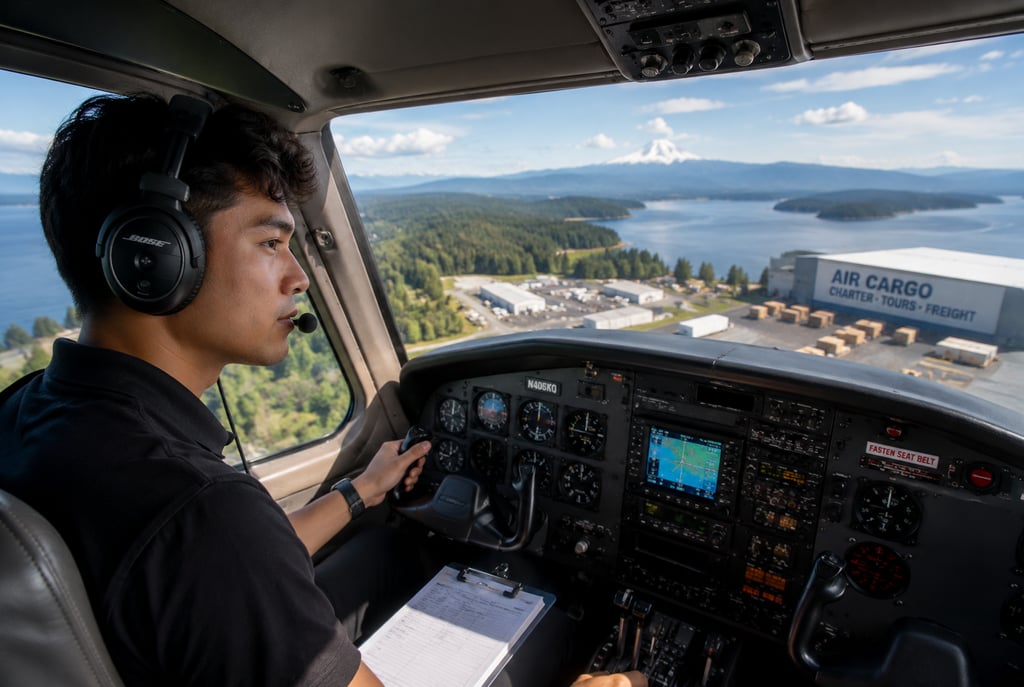
There's a job where you're paid to fly airplanes — hauling cargo through the night, flying charters, running aerial tours, dusting crops, teaching the next set of pilots — and you can get there without a four-year degree. It's called a commercial pilot, and it's one of the highest-paying careers most people never realize is open to them without college. Let's look at what the work is, what it honestly pays, and the one distinction that changes everything.
First principle: the credential that matters is the license, not the diploma
Here's the thing almost everyone gets wrong about flying for a living. When people picture "pilot," they picture the captain of a packed passenger jet — and that path, the airline pilot path, is a different, longer road where a degree really does help. But that's not the only way to be paid to fly. Commercial pilots fly cargo runs, charter flights, sightseeing tours, medical flights, and agricultural planes — and that work is gated by flight certifications and logged hours, not by a bachelor's degree.
Strip it down: in aviation, the FAA license and your hours in the air are the qualification. A plane doesn't care what's on your wall; it cares whether you can fly it safely. That's a field where proven skill beats pedigree — which is exactly the kind of field worth paying attention to.
Second principle: the barrier isn't school, it's flight hours
Here's the assumption worth breaking. We see "professional pilot" and fill in "four years of college first." The real gate is different: it's the hundreds of flight hours and the sequence of FAA certificates you have to earn. That's not cheaper or easier than a degree necessarily — flight training is a real investment of time and money — but it's a different path, one you can start right out of high school and one where every hour you log is a step toward getting paid. The obstacle is airtime, not tuition. Once you understand that, the route gets a lot clearer.
What the job actually is
Commercial pilots fly aircraft for pay outside the major airlines. That covers a huge range: cargo and freight, charter and corporate flights, emergency medical transport, firefighting and aerial survey, crop dusting, banner towing, sightseeing tours, and — very commonly — working as a certified flight instructor to build hours while getting paid. Depending on the job, you might fly solo or as part of a small crew, on predictable routes or on-demand. It's a career for someone who loves flying itself, handles responsibility and weather-driven schedules well, and is willing to build their career hour by hour.
Curious what other careers fit this same "license over degree" pattern? Our guide to the 15 highest-paying jobs without a four-year degree lays out more of them.
What it pays
The median annual wage for commercial pilots was $122,670 in May 2024 (BLS) — more than double the $49,500 median for all workers. The honest spread: the lowest 10% earned under about $59,330, and the top 10% earned more than $239,200.
Two honest notes on that number. First, don't confuse it with the airline pilot figure ($226,600 median) — that's the separate, longer path where a degree effectively is expected. Commercial piloting is the no-degree route, and $122K is a strong median by any measure. Second, the early years are the lean ones: new commercial pilots, especially those instructing to build hours, often start well below the median before their pay climbs with experience, ratings, and the kind of flying they move into. Cargo and corporate flying tend to pay at the higher end. Your income rises with your hours and your certifications — both fully in your control.
How to get in without a four-year degree
Finish high school. Strong math, physics, and a clean medical history matter — you'll need to pass an FAA medical exam.
Train and earn your certificates in sequence. Start with a Private Pilot License, add an Instrument Rating, then earn your Commercial Pilot License through an FAA-certified flight school. This is the core credential that lets you legally fly for pay.
Build your hours. This is the real work of the early career. Many new pilots earn their Certified Flight Instructor (CFI) rating and get paid to teach while logging the hours that open bigger opportunities.
Get hired and specialize. Move into cargo, charter, corporate, medical, or agricultural flying. Each rating you add and every hour you log raises your value and your pay.
You can start flight training right out of high school and be paid to fly — with no four-year degree and no student-loan-for-a-diploma hanging over you.
Is it worth it?
The field is projected to grow 4% through 2034 — about average — with roughly 18,200 openings a year across airline and commercial pilots combined, many from a wave of retirements. Aviation is cyclical, so demand rises and falls with the economy, but the long-run need for pilots is real.
The honest tradeoffs are important here. Flight training costs real money upfront — this isn't a paid apprenticeship like some trades, and you should go in with eyes open about the investment to reach your hours. The early-career pay is modest while you build time. Schedules follow the flying: nights, weekends, weather delays, and time away from home are part of the deal. And the medical requirements are strict — a disqualifying condition can end the path. But for someone who genuinely wants to fly for a living, this is the route that doesn't require a bachelor's degree, and the ceiling is high.
The principle underneath it all: the degree was never the thing — the skill and the license are the thing. You don't need four years of college to be paid to fly. Layer the training, earn the certificates, log the hours, add daily effort, and you build a stable, meaningful, well-paid life in the air.
Ready to map your own path? The Foundational Bundle gives you all three of our core guides plus a workbook: More Paths Than You Think (high-paying careers without a four-year degree), the Post High School Plan (how to build your path step by step), and The AI Guide for Life After High School (how to put AI to work in whatever career you choose). Everything you need to pick a direction, build the skills, and turn them into income — no four-year degree required.
Just want the career roadmap? More Paths Than You Think is available on its own.